
Abstract
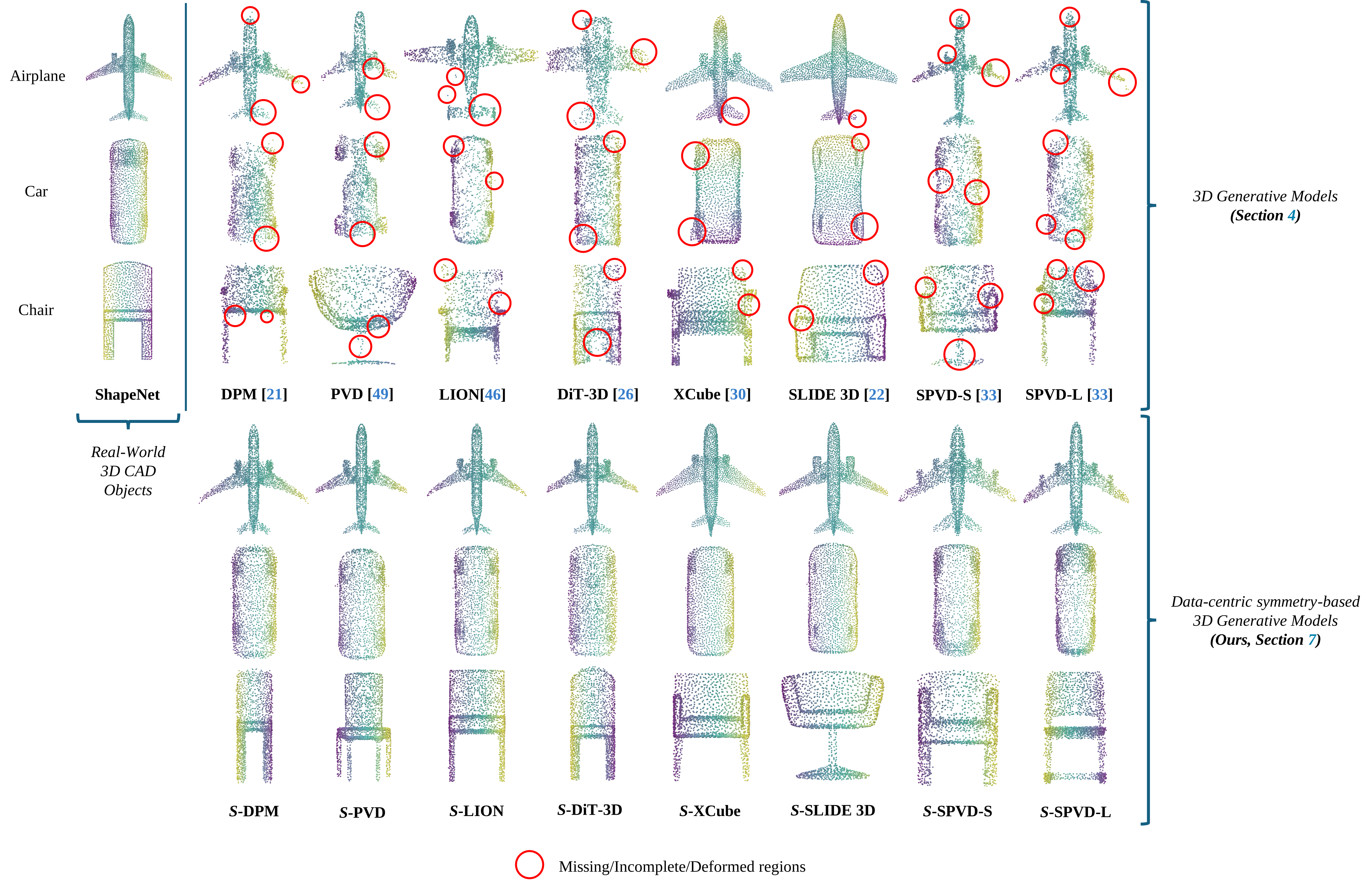
Symmetry is a strong prior present in many object categories, yet standard benchmarks for 3D generative models rarely report whether this prior is preserved. We study symmetry preservation in unconditional point cloud generation. We first audit the symmetry of generated shapes by several 3D generative models and compute a normalized symmetry score based on the Chamfer Distance (CD). We show that although current 3D generative models achieve competitive results under standard evaluation, they reveal a persistent symmetry gap when a symmetry-aware evaluation protocol is applied. To test whether this gap is merely inherited from the training data, we evaluate these models over a mirrored-objects dataset derived from ShapeNet and analyze symmetry dynamics during training. Mechanism-inspired diagnostic tests were conducted at the sampling and latent-representation levels to further show that reflection symmetry is not reliably encoded in the learned generative process. Finally, to address this gap, we propose a data-centric symmetry-based intervention: training generative models on a half-objects dataset and reconstructing full objects by reflection during sampling. Across multiple backbones, this intervention substantially improves geometric consistency and visual plausibility while remaining competitive under standard metrics. These findings suggest that symmetry-aware evaluation is needed alongside standard benchmarks, and future 3D generative models should incorporate this prior explicitly, either during training or sampling.
Symmetry Audit of Current 3D Generative Models
We show that current 3D generative models do not reliably preserve the reflection symmetry present in training datasets such as ShapeNet. Although these models achieve competitive results under standard evaluation metrics, their generated shapes exhibit a persistent symmetry gap when evaluated using a symmetry-aware protocol.
To quantitatively evaluate the degree of reflection symmetry in a 3D shape, we introduce the Normalized Symmetry Chamfer Distance (NSCD). Given a point cloud \(P\), we reflect it across the canonical symmetry plane \(x = 0\), obtaining \(\mathcal{R}(P)\), and compute:
Here, \(\operatorname{CD}(P,\mathcal{R}(P))\) denotes the Chamfer Distance between the original point cloud and its reflected version. The term \(\operatorname{diag}(P)\) represents the length of the diagonal of the axis-aligned bounding box of \(P\). The squared diagonal normalizes the Chamfer Distance with respect to object scale, enabling fair comparisons across shapes, categories, and generative models.
Lower NSCD values indicate stronger reflection symmetry, whereas higher values indicate greater geometric asymmetry. We apply this metric to both existing 3D shape datasets and samples produced by current 3D generative models. The resulting NSCD distributions are summarized using histograms to reveal differences between real and generated shapes.
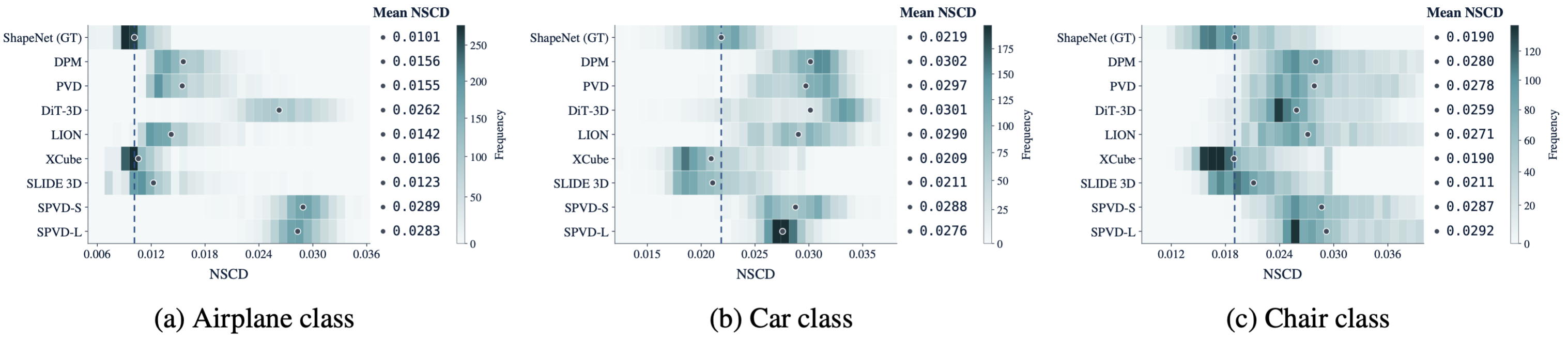
Symmetry evaluation across 3D generative models. Results correspond to the models trained over the original ShapeNet dataset. Ground-truth results from ShapeNet are provided for reference. The vertical dashed line highlights the mean symmetry score of the ground-truth distribution.
After showing that objects generated by SOTA 3D generative models do not preserve the symmetry distribution of the training data, we construct a new dataset of fully symmetric objects derived from ShapeNet. This dataset is created by reflecting the original objects across the canonical symmetry plane. Our goal is to determine whether the observed symmetry gap is inherited from the training data or whether generative models fail to learn this prior internally. The results show that even when the training objects are fully symmetric, the generated samples remain far from the symmetric distribution of the training dataset.
We then employ diagnostic techniques inspired by mechanistic interpretability to inspect symmetry at both the sampling and latent-representation levels. At the sampling level, we observe that even when the input noise is explicitly symmetrized during generation, the models can still produce substantially different objects. At the latent level, the representations of an object and its reflected counterpart remain distant in the latent space. These findings suggest that reflection symmetry is not reliably encoded in the internal generative process.
Our Intervention
To explicitly enforce reflection symmetry, we train 3D generative models on half-object representations and reconstruct complete shapes by mirroring the generated half across the canonical symmetry plane. This simple data-centric symmetry-based intervention guarantees symmetric outputs without modifying the model architecture.
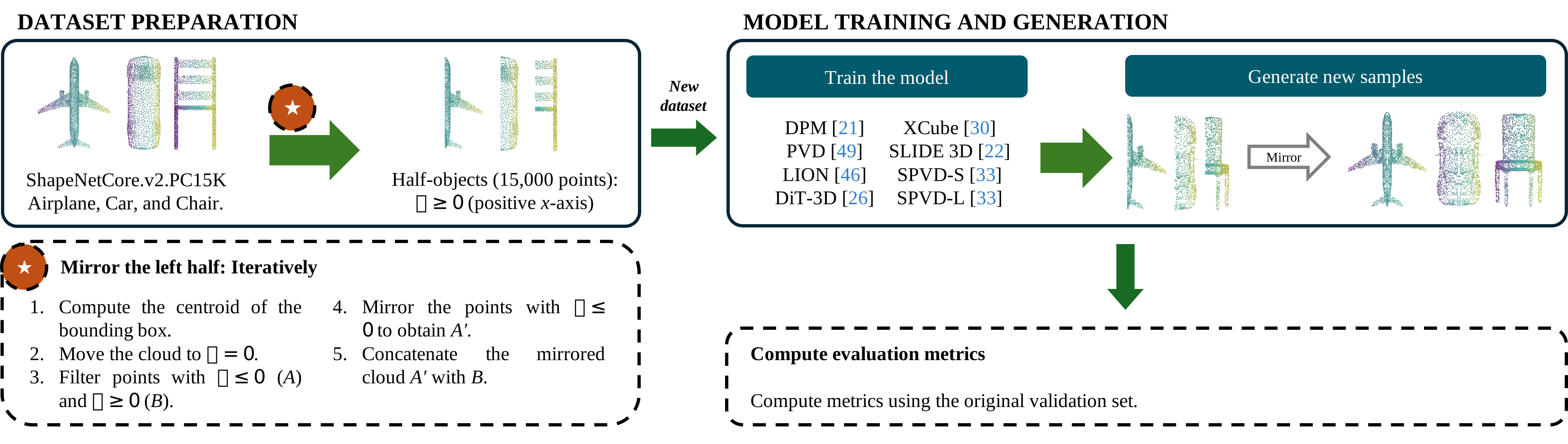
Overview of our proposed pipeline. The process begins with dataset preparation, where objects from ShapeNet are aligned and mirrored along the plane x = 0 to obtain right-side half-objects (x >= 0), each containing 15,000 points. During generation, the synthesized half-objects are mirrored across the plane x = 0 to reconstruct full shapes, which are subsequently evaluated using the original validation set.
Results
Across multiple generative backbones and object categories, our intervention substantially improves symmetry preservation, geometric consistency, and visual plausibility. At the same time, the resulting models remain competitive under standard 3D generation metrics.
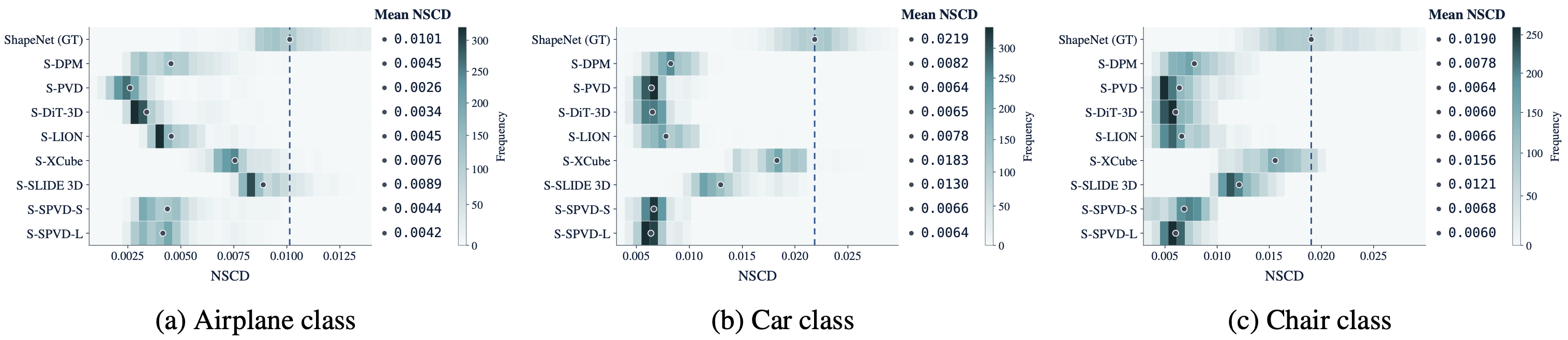
Symmetry evaluation across 3D generative models. Results correspond to the models trained over the half-objects ShapeNet dataset. Ground-truth results from ShapeNet are provided for reference. The vertical dashed line highlights the mean symmetry score of the ground-truth distribution.
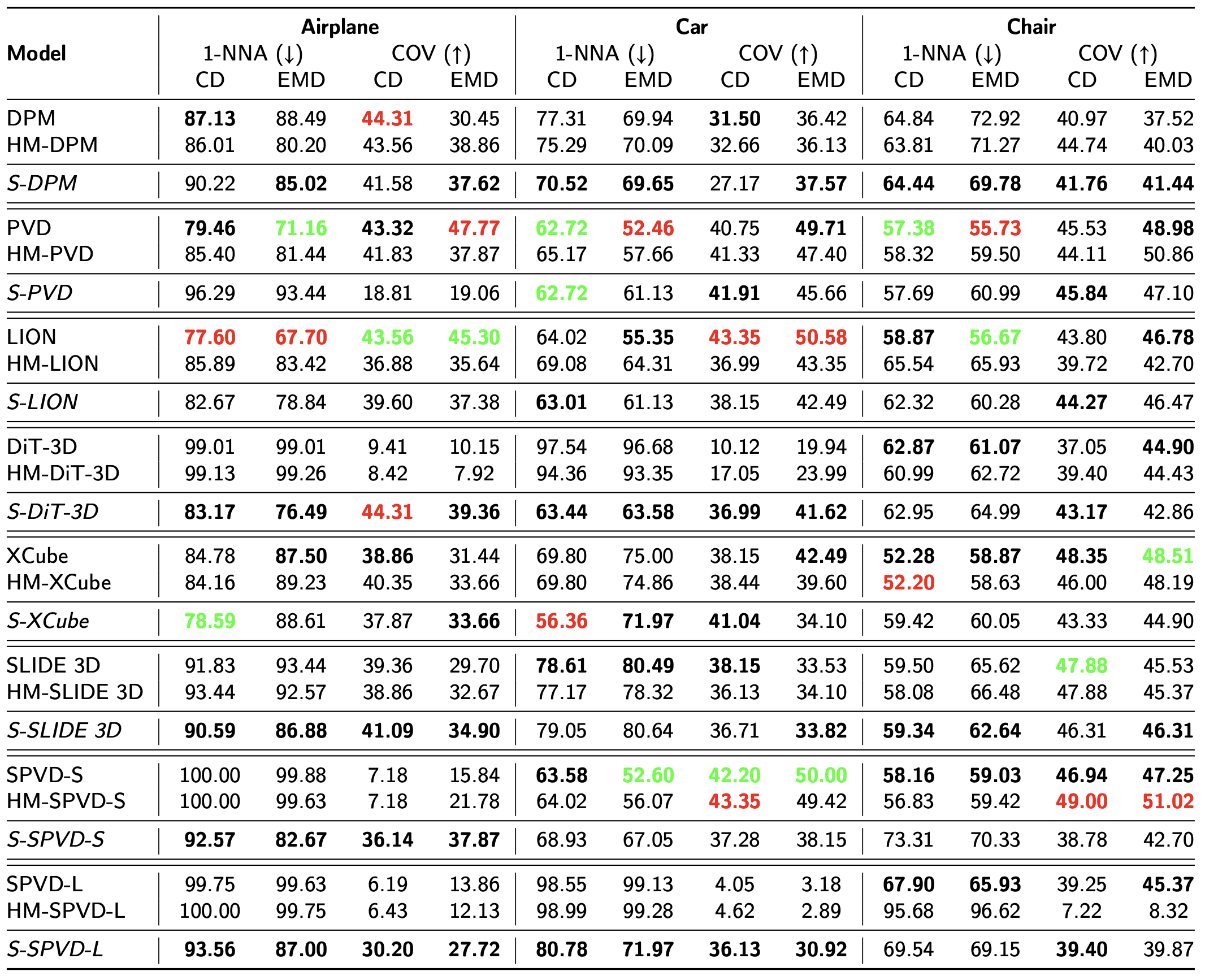
Generation results on Airplane, Car, and Chair compared with original models’ results using 1-NNA↓ and COV↑ as metrics. Both CD and EMD are computed as distance metrics, and reported as percentages (%). Bold values highlight better model-specific results. Red values highlight better class-specific results. Green values highlight competitive results against benchmarks.
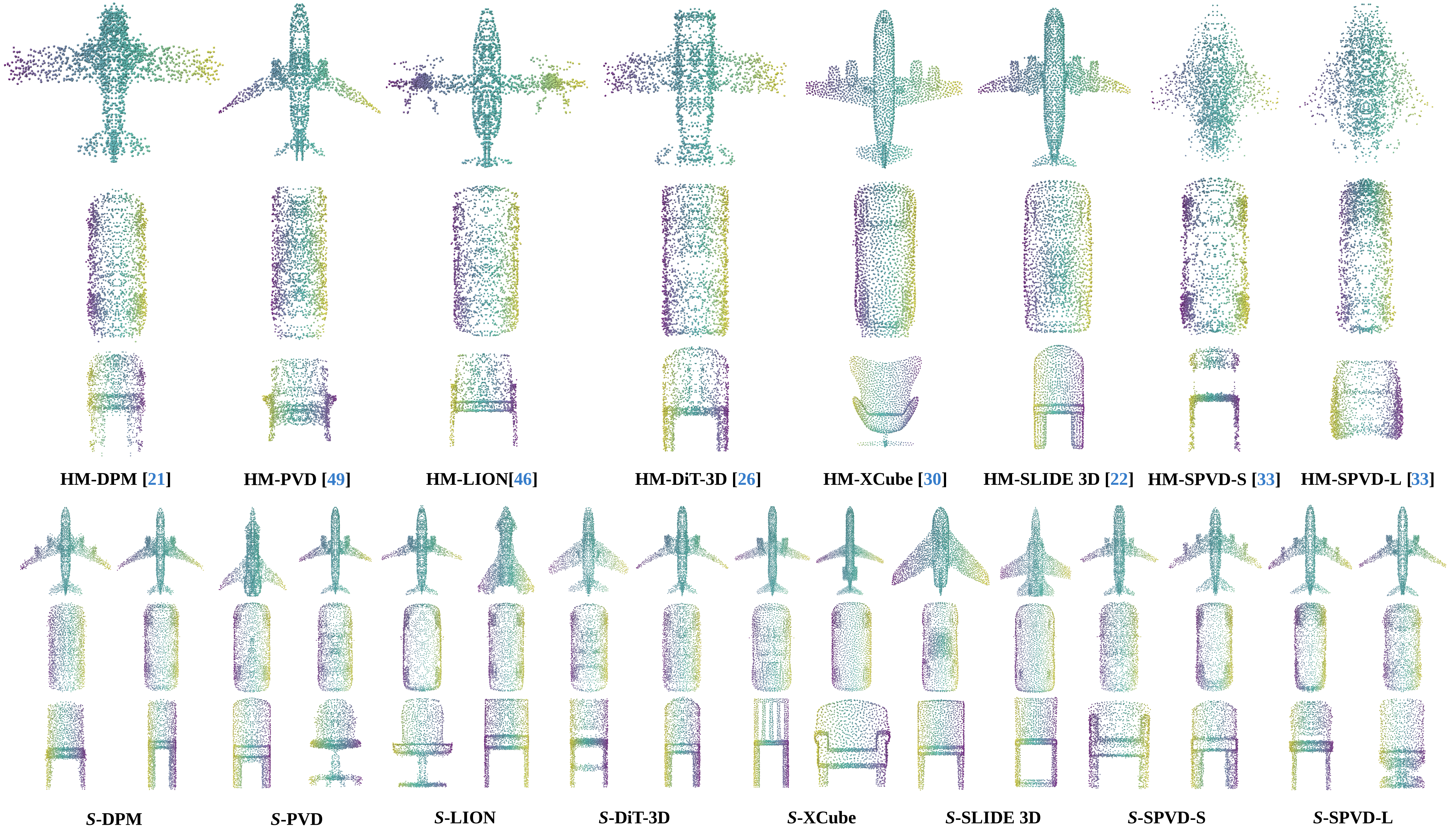
Ablation study results: Qualitative comparison between post-hoc half-mirroring and our data-centric symmetry-based approach. Top: Half- mirrored reconstructions obtained from samples generated by the original models. Bottom: Objects generated by our proposed approach.
BibTeX
@misc{caytuiro2026symmetrymattersauditingsymmetrizing,
            title={Symmetry Matters: Auditing and Symmetrizing 3D Generative Models},
            author={Nicolas Caytuiro and Ivan Sipiran},
            year={2026},
            eprint={2512.18953},
            archivePrefix={arXiv},
            primaryClass={cs.CV},
            url={https://arxiv.org/abs/2512.18953},
        }