
SHREC 2026: Reconstruction of High-Frequency Geometry in Synthetic Heritage
We also provide download scripts:
Bash Script Downloader Python Script Downloader


Abstract
Cultural heritage artifacts are often defined not by their global shape, but by fine-grained surface details—engravings, erosion patterns and reliefs. Standard 3D metrics often fail to capture these high-frequency nuances. SHREC 2026: High-Frequency Geometry challenges researchers to reconstruct detailed 3D meshes from multi-view synthetic renderings.
We introduce a novel procedurally generated dataset of sculpted stone artifacts with feature-aware ground truth. Key features of this track include:
- Task: 3D reconstruction based on localized surface features, from 90 high-quality synthetic renderings per object.
- Metric: A "Semantic Weighting Scheme" prioritizing semantically significant features (e.g., corners, reliefs) over flat surfaces.
- Replicability: Our procedural pipeline allows for full reproducibility. We align with the Graphics Replicability Stamp Initiative.
- Publication: All results will be compiled into a joint paper to be submitted to Computers & Graphics upon acceptance.
This track is designed to challenge and evaluate the ability of state-of-the-art algorithms to capture high-frequency geometric details critical to heritage documentation and analysis.
Dataset Samples
Participants will be provided with 90 rendering captures around the generated objects. Here are some captures for the dataset.
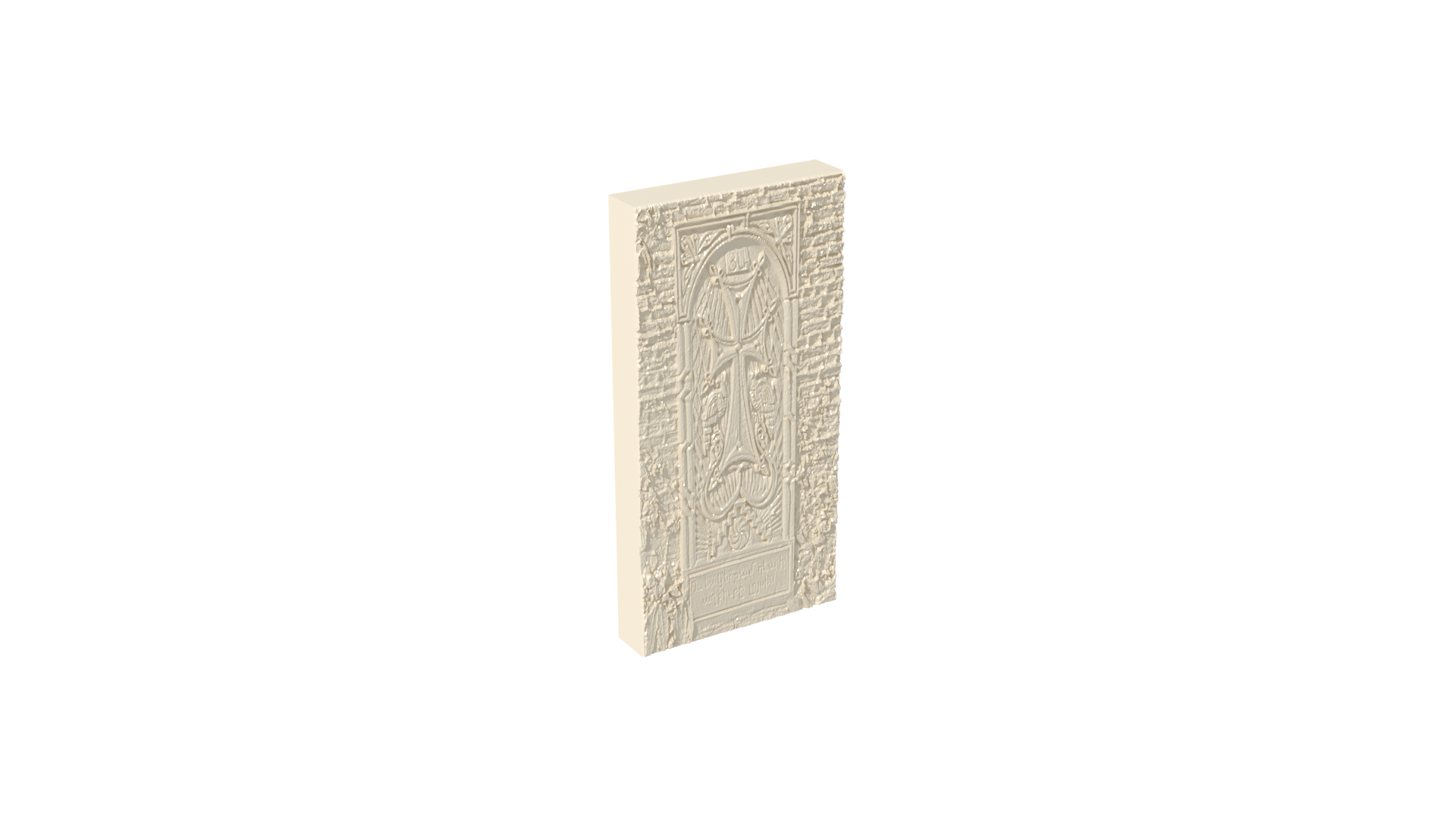
Rendering for object 0001, realistic version.
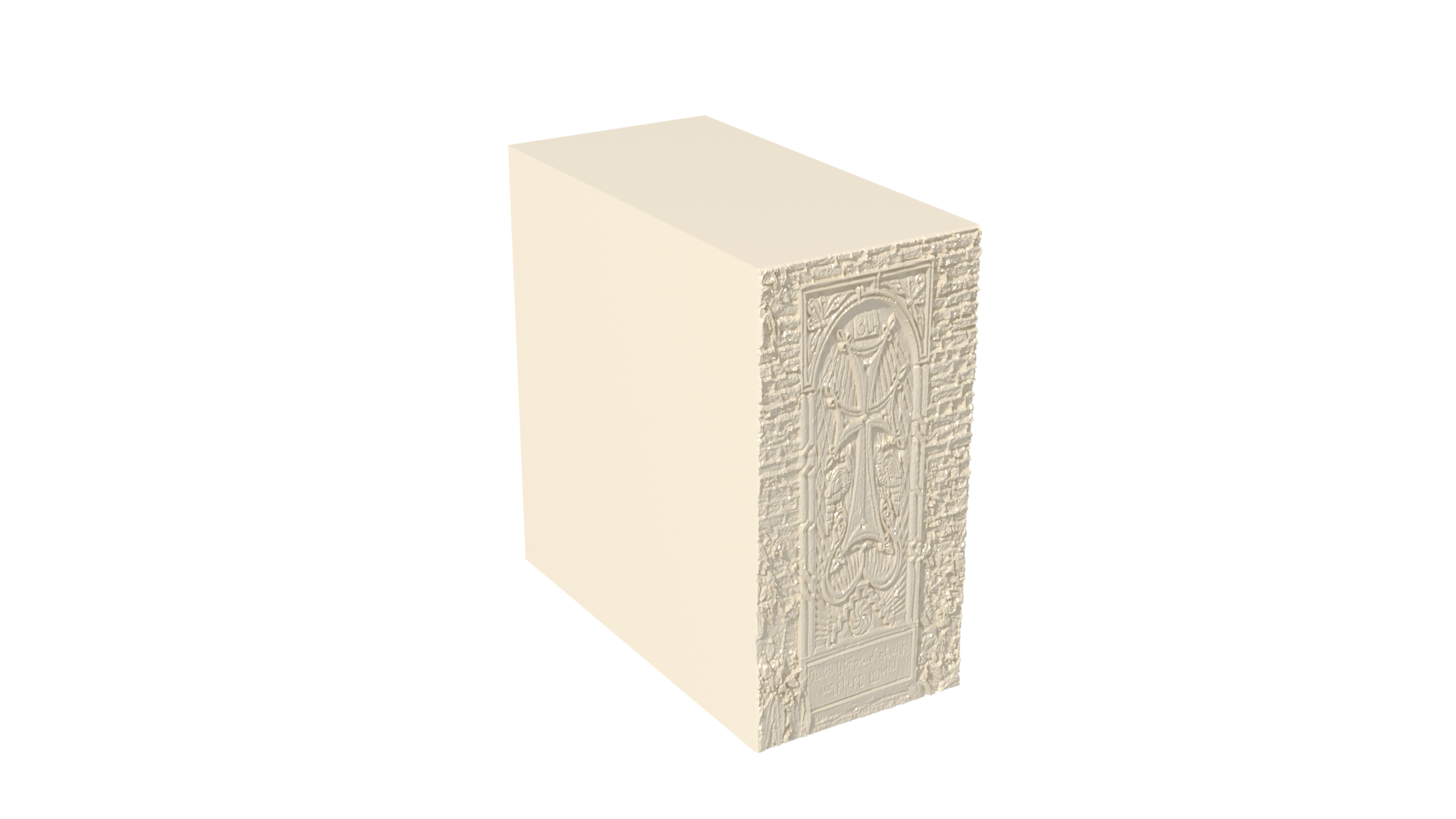
Rendering for object 0001, large version.

Rendering for object 0001, normal version.
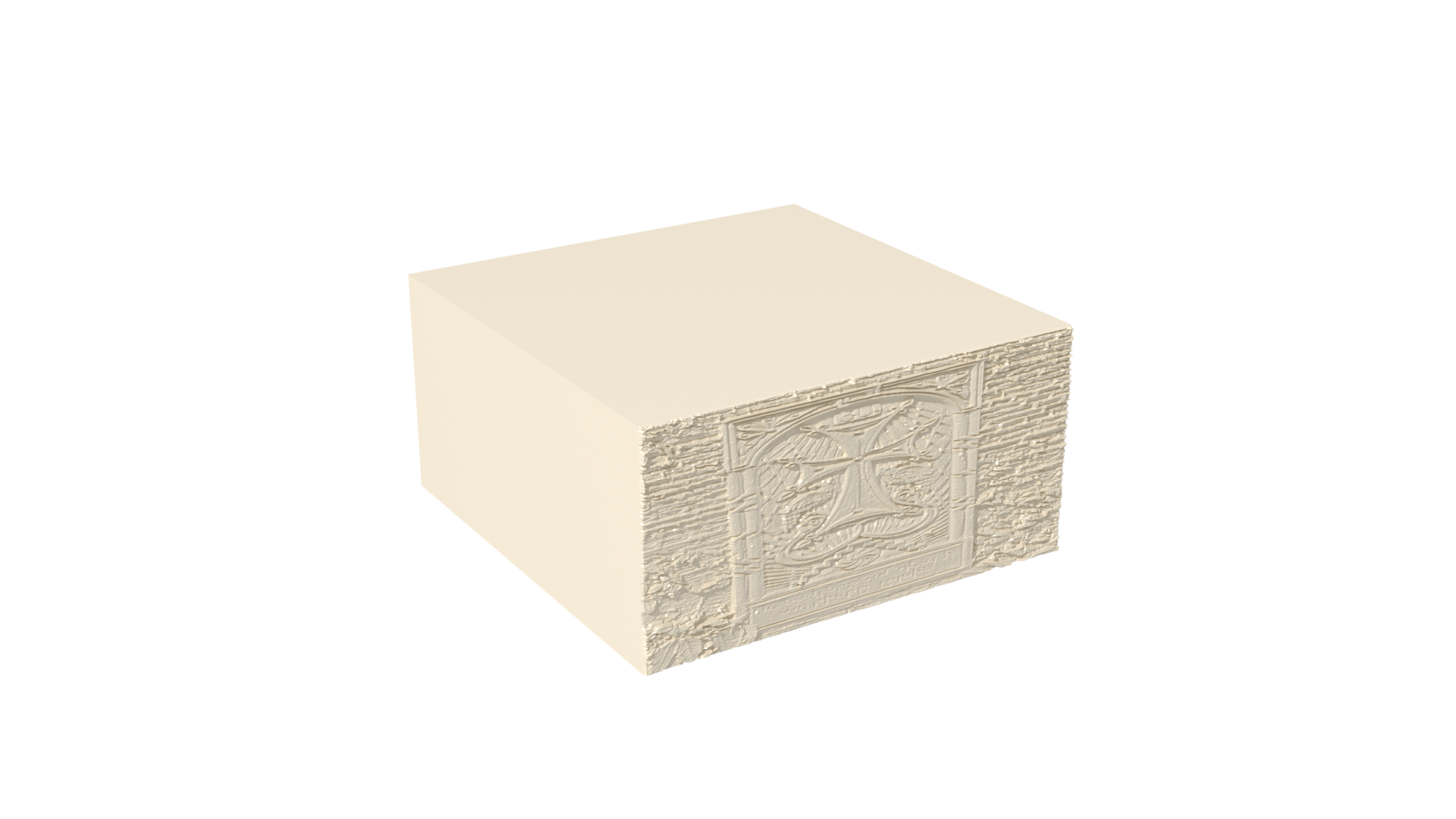
Rendering for object 0001, wide version.
The Task & Dataset
Goal
Participants are provided with 90 high-quality 2D renderings per object, simulating a realistic capture setup (physically based materials, dual-sun lighting, HDRI maps). The goal is to reconstruct the original 3D object from these images. While researchers may employ any reconstruction method (Photogrammetry, NeRF, Gaussian Splatting, etc.), the challenge emphasizes the geometric fidelity of surface details (engravings and reliefs).
Dataset Characteristics
The dataset consists of procedurally sculpted meshes derived from a canonical cube.
- Input: 90 PNG images (1920×1080) per object.
- Materials: Approximated diffuse stone (high roughness, low metallicity).
- Camera Poses: We provide full camera intrinsics and extrinsics in COLMAP format for every image.
Geometric Deformations (Derivatives)
To test the robustness of reconstruction algorithms across different topologies, our dataset extends beyond the canonical cube. We apply a novel deformation method to the four base styles (Normal, Large, Realistic, Wide), resulting in 6 geometric derivatives for each style.
They are complex 3D shapes morphed into the topological semblance of: Cone, Cylinder, Egg, Package, Pyramid and Sphere.
Evaluation: Semantic Weighting
We utilize a novel Semantic Weighting Scheme where reconstruction errors are weighted based on vertex importance in the ground truth:
| Category | Importance | Description |
|---|---|---|
| Sculpted Reliefs | High | Artistic/historical surface content. |
| Corners | High | Structural integrity. |
| Edges | Medium | Sharp transitions. |
| Flat Faces | Low | Baseline geometry. |

Visualization of per-vertex semantic weights.
Dataset Reproducibility
We take an image and sculpt the content into a 3D mesh. After that, we render 90 images in Blender with realistic conditions.


Registration
To participate in this track, please register by sending an email to cllull@dcc.uchile.cl. Please include the name of your team members and your institution. Registered participants will receive updates regarding the dataset and submission guidelines.
Schedule
| Date | Event |
|---|---|
| January 12, 2026 | Track begins / Dataset Release |
| March 15, 2026 | Registration Deadline (Recommended) |
| April 3, 2026 | Submission Deadline for Reconstruction Results |
| April 4-12, 2026 | Evaluation and Results Processing |
| April 20, 2026 | Submission of full paper to SHREC |
| May 25, 2026: | First review done, notification of paper acceptance |
| July 3, 2026: | Second stage of reviews complete, decision on acceptance, rejection, or acceptance as short paper. |
| July 30, 2026: | Final decision on acceptance or rejection. |
| Sept 3-4, 2026 | Presentation at Eurographics 2026 (3DOR) |
Submission
Please, upload the dataset to any public repository (e.g., Google Drive, Dropbox, etc.) and share the link with us via email.
The submission email address is
cllull@dcc.uchile.cl.
If you have problems uploading large files, please contact us via email. Also, if you have problems with time, please contact us before the submission deadline (you may consider uploading an MD5 file).
Contact
      • Cristián Llull: cllull@dcc.uchile.cl
      • Iván Sipirán: isipiran@dcc.uchile.cl
      • Nelson Baloian: nbaloian@dcc.uchile.cl
      • Francisca Gil: francisca.gil@cenia.cl